| Origins | Draws from ancient roots in Middle Eastern and Mediterranean cultures |
| Overview | African folk music encompasses a rich and diverse array of musical traditions developed across the African continent over thousands of years. |
| Influence | Has deeply influenced the evolution of Western popular music |
| Adaptation | Continuously adapting to modern genres and global audiences despite social and technological changes |
| Importance | Remains a vital living tradition, serving cultural, spiritual, and entertainment roles for communities |
The musical traditions of Africa represent some of the oldest and most diverse in the world, tracing their origins back thousands of years to the dawn of human civilization. Emerging from ancient cultural and trade connections with the Middle East and Mediterranean region, African folk music has evolved into a remarkably varied tapestry of regional styles, instruments, and performance practices across the vast continent.
The earliest known African music dates back to at least 10,000 BC, with the discovery of some of the world's oldest known musical instruments such as bone flutes and hand drums in places like Wonderwerk Cave in South Africa. These ancient musical traditions were closely intertwined with spiritual beliefs, storytelling, and the rhythms of daily life.
As early African civilizations like Ancient Egypt, Kush, and the Mali Empire rose to prominence, their musical cultures also flourished. Egyptian harps, lyres, and percussion instruments became iconic, while West African griots (oral historians) developed complex, improvisational vocal styles accompanied by thumb pianos, balafons, and other percussive instruments.
Meanwhile, in East Africa, Horn African traditions blended indigenous styles with the influence of the Arabian Peninsula and Persia, giving rise to the oud-based music of Somalia and Ethiopia. And in Central Africa, the Kongo Kingdom and other ancient polities developed polyrhythmic drumming and cyclical call-and-response singing.
Over centuries, these ancient musical foundations diversified into an astonishingly rich tapestry of regional folk traditions across the African continent. From the Berber lute music of the Sahara Desert to the soukous dance rhythms of the Congo Basin, each area developed its own distinct instrumental, vocal, and performance styles.
In West Africa, highlife emerged from the fusion of native musical elements with colonial-era guitar, brass instruments, and jazz. Meanwhile, the music of the Sahel region, including styles like Touareg music and Gnawa, is known for its modal melodies and hypnotic polyrhythms.
Further south, the mbira thumb piano and marimba xylophone are central to the rich musical heritage of Southern Africa, from Zimbabwe to Mozambique. And the horn-based dance music of East Africa, including benga from Kenya and taarab from Zanzibar, demonstrates the region's connections to the Indian Ocean world.
African folk music has had a profound and lasting impact on the development of popular music worldwide, particularly in the West. The rhythmic structures, call-and-response vocal techniques, and improvisational qualities of African traditions can be heard in the emergence of blues, jazz, rock and roll, and other American music genres.
Ragtime pioneer Scott Joplin, jazz legends Louis Armstrong and John Coltrane, and rock innovators like Jimi Hendrix and Fela Kuti all drew heavily on the musical languages of Africa. Even the four-beat meter that underpins much of Western popular music has origins in ancient sub-Saharan drumming patterns.
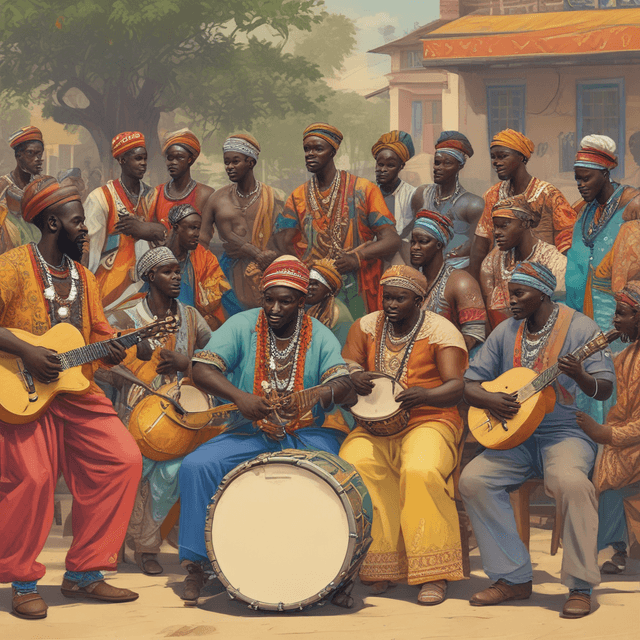
African folk music is characterized by an incredibly diverse array of traditional instruments, from the kora harp-lute of the Sahel to the mbira thumb piano of Southern Africa. Percussion is particularly central, with a wide variety of drums, xylophones, shakers, and other rhythmic tools.
Vocal styles also vary greatly, from the powerful, ornamented singing of griots to the chanted, cyclical styles of pygmy and Kalahari cultures. Group performance, often with call-and-response structures, is integral to many African musical traditions, reflecting the communal nature of the art form.
Music has always played a vital role in the cultural, social, and spiritual life of African communities. Folk songs, chants, and dances are closely tied to rites of passage, harvests, religious ceremonies, and other aspects of community experience. Instruments like the balafon of West Africa and the litungu lyre of East Africa are seen as sacred, with their making and playing governed by cultural protocols.
Even as African societies have undergone rapid modernization, these ancient musical traditions have proven remarkably resilient, continuously evolving while maintaining their roots. Contemporary African musicians seamlessly blend traditional elements with electronic music, hip hop, and other global genres, ensuring that the continent's rich musical heritage remains a vital, living tradition.
In recent decades, African folk music has gained unprecedented global recognition and popularity. Renowned artists like Youssou N'Dour, Salif Keita, and Angelique Kidjo have brought the diverse sounds of the continent to worldwide audiences. Music festivals like the WOMAD Festival and the Harare International Festival of the Arts showcase the remarkable breadth of African musical expression.
As the world becomes increasingly interconnected, the unique, time-honored musical cultures of Africa continue to inspire and influence artists, listeners, and cultural movements worldwide. From the ancient melodies of the Sahara to the pulsing rhythms of Kinshasa, African folk music stands as a living testament to the continent's remarkably rich and enduring musical heritage.
